Mohonk Preserve’s Community Science Program, launched in 2014, invites members of the community to engage in scientific research and long-term ecological monitoring through direct participation in natural history observation, data collection and analysis. This program aims to provide educational and science-based volunteer opportunities for participants of all ages and experience levels and promote a deeper understanding of the local impacts of climate change.
Community Science Volunteers
- Receive training and support from Preserve staff and experienced volunteer leaders
- Become a critical part of the Conservation Science team’s efforts on the Shawangunk Ridge.
- May participate in a wide range of ongoing studies and projects
Community Science Volunteer Opportunities Include:
Phenology Trail
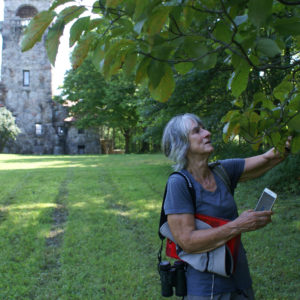
Record the timing of seasonal events of specific flora and fauna species at the Foothills Phenology Trail. (Year-Round)
Phenology can be considered Nature’s calendar. It is the study of seasonal and cyclical changes in plants and animals, like the flowering of plants, the emergence of insects, or the migration of birds.
The timing of these events are influenced by environmental triggers (sunlight, temperature, and precipitation) making phenology a leading indicator of climate change.
Phenology records around Mohonk Lake date back to 1925, when Daniel and Keith Smiley started noting the date of spring bird arrivals. The Preserve’s Daniel Smiley Research Center continue this tradition of natural history observation and have expanded the scope of the Smileys’ phenology records to monitor seasonal changes in plants and other fauna at Mohonk Preserve on local, regional, and national levels.
Phenology Trail Volunteer Observers document distinct stages in select trees, shrubs, wildflowers, butterflies, amphibians, and reptiles throughout the year. The Mohonk Preserve Foothills Phenology Trail is accessible from our Testimonial Gateway Trailhead.

Volunteer as a Phenology Observer
- Join a dynamic group of volunteers
- All ages and experience levels are welcome
- No prior science or research background required
- Receive training and group learning opportunities and workshops
- Spend time outdoors
- Scheduling incredibly flexible
- Hone skills in data collection, species identification, and botany
- Gain a deeper understanding of the local impacts of climate change
- Receive the Phenology Trail Newsletter to see what is happening out on the trail
When and How to Observe
- Once trained, volunteers observe on their own schedule and submit their data online within 24 hours.
- Observers document specific life cycle stages occurring for a given species at each visit.
Resources:
StreamWatch
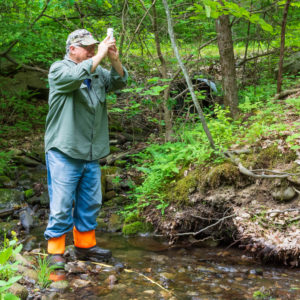
Monitor stream water quality and habitat characteristics. (March-November)
Community scientists collect conservation-based water quality data within the Kleine Kill and Coxing Kill watersheds. These watersheds are located on the Shawangunk Ridge and drain into the Hudson River via the Wallkill River and Rondout Creek.
Volunteer community scientists are trained in specific data collection and naturalist observation protocols and conduct regular monitoring in these two watershed areas. StreamWatch data allow researchers and land managers to evaluate water quality, identify vulnerable or invasive species, determine the need for riparian buffers and changes to current agricultural practices, and inform future Mohonk Preserve projects.
Volunteer Requirements:
- Attend group orientation and individual site orientation
- Desire and ability to hike to stream locations (sometimes off-trail) with provided sampling equipment
- Required personal equipment includes waterproof footwear (rubber boots, water shoes, old sneakers that can get wet)
- Collecting data in volunteer pairs is required; staff will work to assign volunteers if you cannot sign up with another person
- Collect and enter data online at least once per month
Resources
The StreamWatch program at Mohonk Preserve launched in the summer of 2017 with support from a grant from the New York State Environmental Protection Fund through the Hudson River Estuary Program of the New York State Department of Environmental Conservation.
Forest Guardians
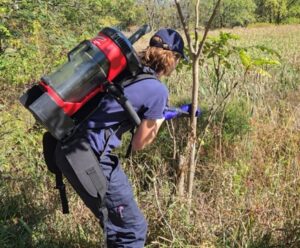
The Forest Guardians program is focused on invasive species mitigation to support the health and management of our forest habitat. The species that we focus on for management can change from year to year depending on Conservation Science priorities, sometimes focusing on 1-5 species in a given year.
In 2026, our work will concentrate on three major projects:
1. Spotted Lanternfly Early Detection and Rapid Response:
-
-
- New York State Department of Environmental Conservation (DEC) Invasive Species Grant Program is a unit within the Division of Lands and Forests, to increase the state’s ability to reduce the impacts of invasive pests by partnering with municipalities, not-for-profits, and academic institutions.
- In January 2024, the Mohonk Preserve received funding from the DEC Invasive Species Grant Program in support of a project to implement early detection, rapid response, and controls for Spotted Lanternfly, commonly known as SLF. 2026 marks our third, and final, year of this grant project.
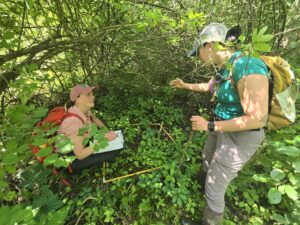
- Forest Guardian activities include assisting with detection, mapping, monitoring, and destruction of SLF egg masses/nymphs and adults, as well as Ailanthus altissima (aka tree-of-heaven), the SLF preferred host tree. This project also aims to increase public awareness of SLF and Ailanthus through event programming, media communications, and new signage at our trailheads.
-
2. Northern Hardwood Eastern Hemlock Forest Restoration Efforts
-
-
- The Natural Resources Conservation Service (NRCS) Environmental Quality Incentives Program (EQIP) provides technical and financial assistance to forest landowners to address natural resource concerns.
- In 2025, Mohonk Preserve’s Climate-Adapted Hemlock Forest Management Plan was approved through this program, securing us funding for hemlock forest management between 2025-2030.
- As part of this program, Mohonk Preserve will be completing brush management for invasive species in the Upper Coxing, Lower Coxing, and Shongum Path forested areas.
- Forest Guardians will assist Conservation Science staff with manual invasive species removals and planting native shrub species.
- Major species of concern in these forested areas include:
-
3. Kleine Kill Restoration Project
-
-
-
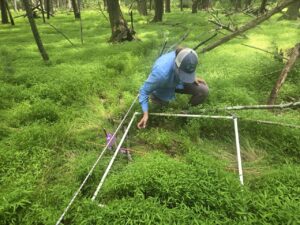
Mohonk Preserve technician sampling a plot of stiltgrass In 2025, Mohonk Preserve entered a long-term project aiming to remove an on-site low-hazard dam and restore a portion of the Kleine Kill stream, which flows into the Wallkill River, a tributary of the Hudson River. The main goal of the project is to restore habitat and its ability to serve as a high-quality environment for New York State species of greatest conservation need. As part of the restoration process, water from the existing pond is slowly drained so that dam removal is more feasible. As the water is depleted from the habitat, we expect current vegetation species to spread and new species to emerge from the seed bank; unfortunately, some of these current and newly emerging plant species are invasive.
- Forest Guardians will assist Conservation Science staff with manual invasive species removals and planting native shrub species.
- Major species of concern in this area include:
-
-
Volunteer Requirements:
-
- Attend group orientation (virtual, with separate field training)
- Desire and ability to hike (sometimes off-trail)
- Required personal equipment includes protective hand wear (i.e. gardening gloves) and appropriate outdoor clothing
- Volunteers are encouraged to bring their own hand tools like pruning shears, trowels, and shovels (Conservation Science staff will provide some gear, but might not be enough for all participants)
- Volunteers are encouraged to participate two to three times a year
How can I help with these projects?
-
- Forest Guardians support our Conservation Science team through habitat surveys, invasive species removal, and data collection. If interested, please join us for our Forest Guardian Orientation on April 11, 2026, at 9:30 a.m.
Special Projects
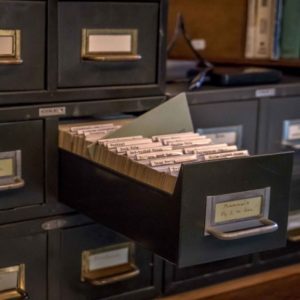
Assist Conservation Science staff and Research Associates with high priority research projects tailored to your skills and interests. (Year-round)
There are many opportunities for volunteers to support the vital work of continuing the legacy of conservation science on the Shawangunk Ridge. These could include partnering with our Research Associates, helping to digitize our world-class collections, or volunteering with Conservation Programs staff on field-based or data analysis projects.
Program needs vary based on current projects and seasonality, and efforts are made to match volunteers with projects that are a good fit for their skills, interests and availability.
Examples of possible projects include:
- Assist Research Associates with monitoring of Lake Mohonk, including water quality indicators and observations of ice cover
- Assist Conservation Science staff with vegetation and bird surveys in grasslands and forests
- Assist with digitization of specimens and records from the Presreve’s Daniel Smiley Research Center collections
- Assist with data curation and organization for Mohonk Preserve’s long-term natural history records
- Record observations of plant, animals and fungi while out on Preserve lands using the iNaturalist application on a phone
Volunteer Requirements:
- Based on program needs and tailored to your skills, interests and availability
- May be done individually or as part of a small group
- Contact Conservation Science staff to learn about current opportunities.
For more information about the Community Science Program contact:
How to apply
To volunteer, simply complete our online application or apply in person at the Visitor Center.
Please note: You must be 18 years of age or older to apply online.
Banner photo by Steve Aaron